
If you have ever stood inside an empty reach-in closet holding a stud finder that beeps randomly—or worse, discovered that your wall studs are spaced 24 inches apart instead of the standard 16—you know how frustrating installing a closet organizer can be.
Wall studs rarely line up right where your brackets need to go. And if you are dealing with metal studs in a newer apartment or thick plaster over drywall, hitting wood behind every mounting point is nearly impossible.
The good news? You do not need to hit every stud to safely hang heavy-duty metal closet shelving. When done right, hollow drywall can support hundreds of pounds of winter coats, denim, and storage bins—provided you use the right anchors and weight-distribution tricks.
Here is the exact, step-by-step method experienced installers use to mount heavy-duty metal shelving on drywall without tearing up your walls, plus an easier alternative if you want to skip drilling altogether.
Why Standard Plastic Wall Anchors Fail in Closets
Before grabbing a drill, throw away those little white or yellow ribbed plastic anchors that come free in most hardware kits. In standard 1/2-inch drywall, a basic expansion plug holds maybe 15 to 25 pounds under shear stress. Once you hang 40 wet-weather jackets on a closet rod, that dynamic pull-out force will rip a plastic anchor straight out of the gypsum board, leaving a quarter-sized crater behind.
To support a heavy-duty metal closet system, your hardware needs to grip the back of the drywall, not just press against the inside of the hole.
Step 1: Choose the Right Heavy-Duty Drywall Anchors
When a bracket lands in hollow drywall between studs, use one of these two contractor-grade anchors:
- Snap-Toggle Bolts (e.g., Toggler Snaptoggle): These are the gold standard for closet tracks and shelf brackets. A metal channel flips flat behind the drywall, spreading the load across a wide surface area. In 1/2-inch drywall, a single 1/4-inch toggle bolt is rated for over 200 pounds.
- Heavy-Duty Self-Drilling Zinc Anchors: Best for medium loads or secondary support points where you don’t want to drill a massive 1/2-inch hole. Avoid the plastic versions—stick to die-cast zinc.
Pro Tip: If you are using a horizontal top-track (hang rail) system, aim to hit at least two wood studs along the span with 2.5-inch #10 wood screws, then fill in the remaining holes every 12 to 16 inches with snap-toggle bolts.
Step 2: Map Your Layout and Check for Obstacles
Grab a 4-foot level, a pencil, and a magnetic stud finder (magnets find the drywall screws holding the sheetrock to the studs, which is way more reliable than cheap electronic sensors).
- Mark your stud centers with painter’s tape.
- Check for electrical and plumbing: Never force a drill bit if you hit sudden metal resistance about 1.5 inches deep—that is likely a steel nail plate protecting wiring or a water pipe.
- Account for your baseboard: If your closet has thick floor molding, remember that vertical standards or floor-standing uprights will sit slightly proud of the wall unless notched or spaced properly.
Step 3: Pre-Drill and Set Your Anchors Flush
Hold your horizontal hang rail or vertical wall bracket against your level pencil line and mark the hole locations.
- Drill your pilot holes using the exact bit size specified on your toggle bolt box (usually 1/2 inch for heavy toggles).
- Slide the metal toggle channel through the hole, pull the plastic straps tight until the metal bar sits flush against the back of the drywall, and snap off the excess plastic zip-tabs.
- Line up your metal shelf bracket and drive the machine bolts in—stop tightening the second the bracket feels snug. Over-torquing will crush the drywall paper face and ruin the anchor’s holding power.
Step 4: Load Your Shelving Strategically
Even with heavy-duty toggles, physics still applies:
- Keep heavy items low: Store heavy sweaters, toolboxes, or seasonal totes on the bottom shelves rather than the top shelf, which experiences the highest outward leverage (cantilever pull).
- Use end-caps and center supports: Never let a wire or ventilated metal shelf overhang a bracket by more than 4 to 6 inches, or the front lip will eventually bend downward.
Want Zero Drywall Holes? Consider a Freestanding Metal Closet System
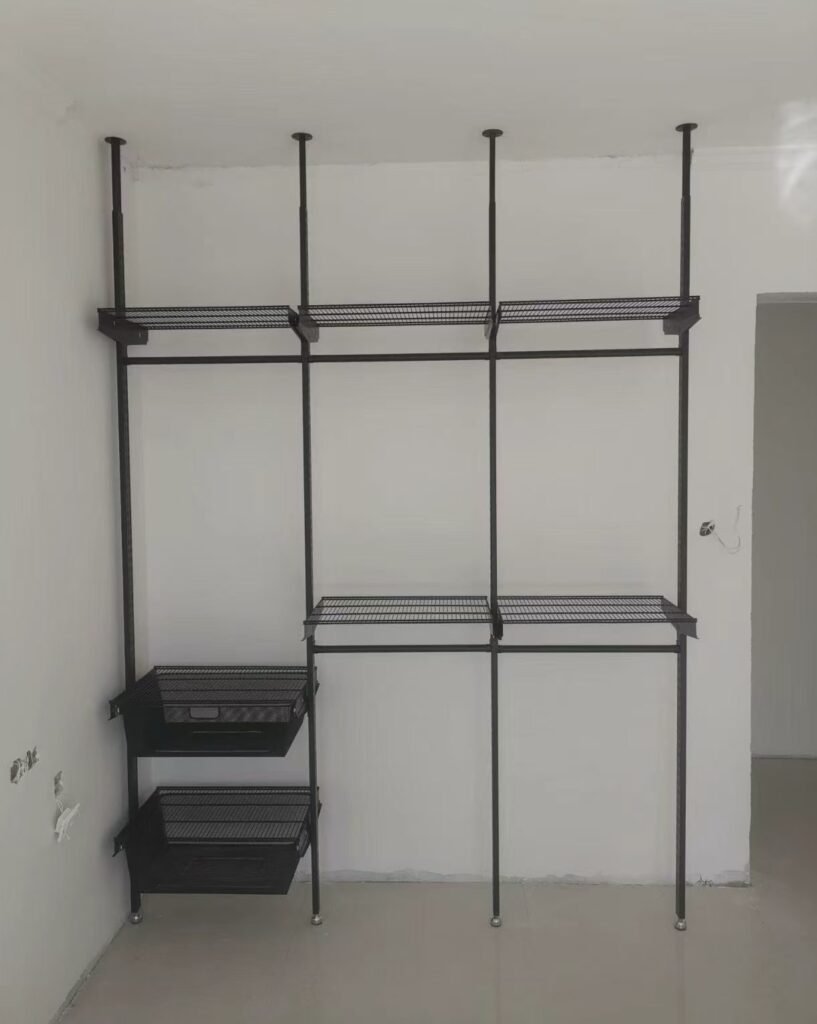
If you are renting an apartment, dealing with tricky metal studs, or simply don’t want to spend a Saturday drilling half-inch holes into your drywall, there is a much faster route: a heavy-duty freestanding metal shelving closet system.
Unlike wall-mounted tracks that rely entirely on drywall anchors to carry the weight, a freestanding steel closet organizer transfers 100% of the vertical load straight down through thick tubular uprights onto the floor.
- No Stud Finder Required: Set it up on carpet, hardwood, or tile in under 30 minutes using adjustable leveling feet.
- Higher Weight Capacity: Heavy-gauge carbon steel poles and reinforced wire shelves easily hold 600 to 1,000+ lbs across the unit without worrying about drywall tear-out.
- 100% Renter-Friendly & Modular: Adjust shelf heights and hanging rods in 1-inch increments as your wardrobe changes—and when you move, disassemble it and take it with you without patching a single wall hole.
Frequently Asked Questions
Can I hang wire closet shelving without hitting any studs at all?
Yes, provided you use heavy-duty toggle bolts rated for at least 100 lbs each and space them every 12 to 16 inches. However, hitting at least one or two studs along the main top rail is always recommended for extra safety.
What size toggle bolt is best for closet shelving?
A 3/16-inch or 1/4-inch snap-toggle bolt works best for most heavy-duty metal closet brackets and hang rails, as the bolt head fits cleanly through standard mounting slots without requiring you to drill out the metal bracket.
How much weight can a freestanding metal closet rack hold compared to wall-mounted shelves?
While a drywall-anchored shelf typically maxes out around 50–75 lbs per linear foot depending on anchor spacing, a quality freestanding metal closet system with 1-inch steel poles can easily support 100 to 150 lbs per shelf—and up to 1,000+ lbs total—without stressing your walls.